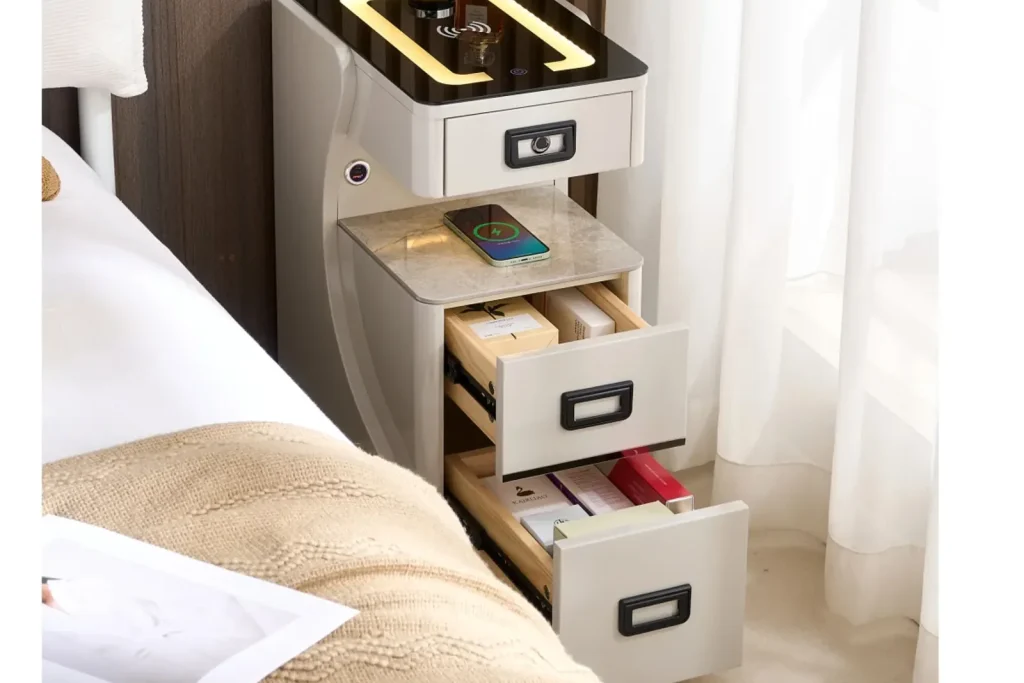
Wireless charging is one of the easiest smart nightstand features for customers to understand. The user places a compatible phone on the marked charging area, and the bedside table becomes part of the daily charging routine. No cable search, no loose adapter on the floor, and no need to unplug a phone from a drawer or wall socket before leaving the room.
That simplicity is why wireless charging deserves its own product discussion. It looks like a small feature, but it changes top-surface design, bedside habits, retail demonstration, supplier specification, packaging, and after-sales responsibility.
Kuan Zhang’s view is that wireless charging should not be treated as a decoration printed on a glass top. It has to work reliably with real phones, real cases, real adapters, and real bedroom behavior.
How Wireless Charging Changes Bedroom Behavior
A normal nightstand holds a phone. A wireless charging nightstand gives the phone a fixed destination. That small change can reduce cable clutter and make the bedside area feel more organized. For users who charge every night, the surface becomes a routine: put the phone down, check the light, and leave it there until morning.
The change is strongest when the charging area is obvious and reachable. If the coil is too far back, too small, poorly marked, or blocked by objects on the top surface, the feature becomes frustrating. If the phone case is too thick or the phone is placed slightly off center, charging may stop. A buyer should assume that customers will not read a long manual before using the feature.
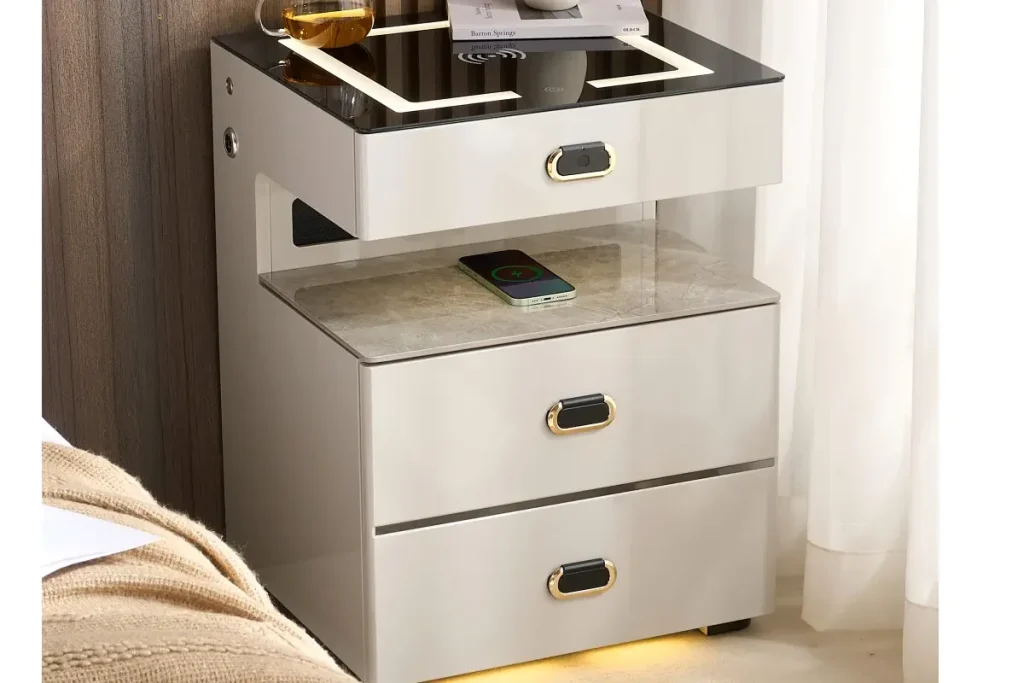
This is why wireless charging belongs in product design, not only in a feature list. The top panel, lighting, drawer handle, lamp position, cup area, and cable exits all affect whether the feature becomes useful in daily life.
Why This Feature Is Useful for Dealers
For dealers, wireless charging creates a simple demonstration moment. A salesperson can place a phone on the top surface and show the customer what makes the nightstand different from a basic bedside cabinet. That is easier to explain than many hidden hardware upgrades.
It also gives dealers a clearer step-up story. A standard nightstand competes mainly on style, material, finish, drawer count, and price. A wireless charging nightstand can be positioned as a lifestyle upgrade for apartments, young families, serviced apartments, student housing, guest rooms, and compact bedrooms where cable clutter is a visible problem.
Dealers should still avoid overcomplicating the pitch. Customers do not need a technical lecture. They need to know which phones are compatible, where to place the phone, whether a case affects charging, whether the adapter is included, and what to do if charging does not start.
Why This Feature Matters for Buyers and Importers
For buyers, wireless charging can help separate a product line from ordinary bedroom furniture, but it also adds testing responsibility. A buyer is no longer checking only panels, handles, runners, paint, and packaging. The buyer must also check the charging module, adapter, cable routing, heat behavior, user instructions, and target-market compliance.
The broader article on the demand shift from nightstands to smart nightstands explains why bedroom furniture is moving toward integrated functions. Wireless charging is one of the clearest examples because it solves a daily user habit without requiring a complex app or connected system.
For sourcing teams, the opportunity is not only to buy a nightstand with a module. The opportunity is to build a consistent product package: charging position, clear markings, tested adapter, clean cable routing, safe heat space, instructions, spare parts, and packaging that protects the electrical area.
What Buyers Should Test on the Sample
The sample should be tested with several common phone sizes and common case thicknesses. Buyers should check whether the phone charges when it is placed naturally, not only when it is positioned perfectly by the factory. If the charging area is too sensitive, customer complaints will follow.
Charging speed also needs careful wording. Unless the supplier can support a specific wattage and standard with documentation, product copy should avoid unsupported claims. It is better to state the included adapter, supported input, module specification, and compatible use conditions clearly than to promise vague fast charging.
The buyer should also test heat. A warm charging surface may be normal depending on device and module behavior, but excessive heat, poor ventilation, or unclear instructions can create after-sales problems. The charging module should not be buried inside a closed area without enough space for cable and heat management.
Top-Surface Design Is Part of the Feature
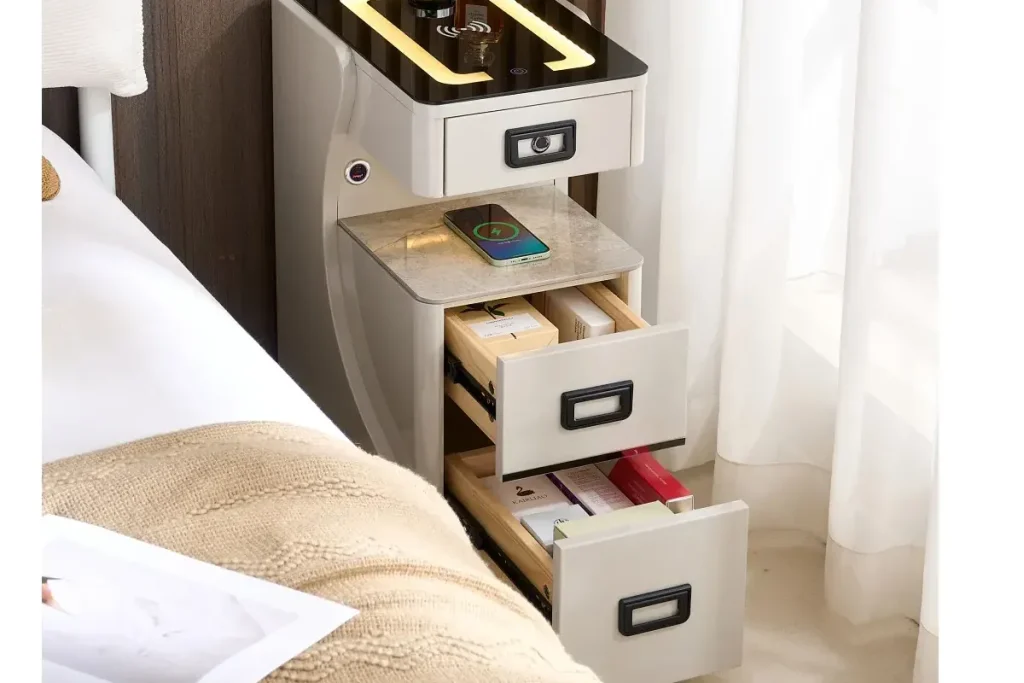
Wireless charging changes the top of the nightstand. The surface needs enough room for a phone, but also for a lamp, book, glass, remote, glasses, and other bedside items. A product that places the charging zone in the only usable space may look clean in a photo but feel crowded in real life.
Materials matter as well. Thick tops, metal layers, decorative glass, stone-look panels, and uneven surfaces can affect charging performance or user perception. Buyers should not approve a sample only by looking at the top material. The sample should be tested with the final top construction, final module, final adapter, and final cable path.
This connects directly with the guide on preparing a furniture product specification sheet before quotation. Wireless charging should be specified with position, module type, adapter, cable length, testing method, marking, instruction wording, and packaging requirements.
Dealer Opportunity: Create a Better Product Ladder
Wireless charging gives dealers a useful way to build a good-better-best ladder. The entry product can be a clean two-drawer nightstand. The middle option can add LED lighting and USB or Type-C ports. The higher option can include wireless charging, better lighting, a lockable drawer, or audio features depending on the market.
This ladder helps sales teams explain price differences. It also helps online stores structure product filters and comparison tables. Instead of showing many similar nightstands with small price gaps, the dealer can organize products by daily-use functions.
The key is to keep the function visible. Product photos should show the charging surface, phone placement, cable path, and bedroom context. A product with wireless charging hidden in a long bullet list may not get the benefit of the feature.
Procurement Opportunity: Build a Stable Feature Package
For importers and sourcing managers, wireless charging creates a repeatable feature package that can be used across several SKUs. Once the module, adapter, marking, instructions, and packaging are tested, the buyer can apply the same logic to different sizes, finishes, and bedroom collections.
This is where supplier capability matters. A factory that can install the module is not automatically good at module testing, cable management, documentation, or after-sales parts. Buyers should review whether the supplier has a repeatable process for electrical components inside furniture.
The article on smart nightstands and connected bedroom furniture sourcing covers this broader supplier question. Wireless charging is a good starting feature because it exposes whether the supplier can combine furniture production with basic electrical coordination.
Packaging and After-Sales Details
Wireless charging modules are vulnerable to poor packing, cable pulling, adapter loss, and unclear instructions. The carton should protect the top surface and the module area. Accessories should be packed in a fixed position. The manual should show phone placement, adapter use, basic troubleshooting, and warnings about unsupported objects or conditions.
For export buyers, packaging should be tested with the final accessory set. A missing adapter or damaged cable can make the customer think the whole nightstand is defective. The packaging notes in bedroom furniture packaging and loading are relevant because smart functions add more parts that must arrive intact.
Buyer Checklist
- Test charging with several phone sizes, case thicknesses, and natural phone placements.
- Confirm module specification, adapter specification, cable routing, and target-market compliance requirements.
- Check whether the charging area remains usable when the top surface also holds normal bedside items.
- Test heat behavior during a realistic charging period.
- Confirm marking, indicator lights, instruction wording, and troubleshooting steps.
- Check whether the feature still works after drawer opening, normal movement, and packing vibration.
- Protect the top surface, module area, cable, adapter, and accessories in packaging.
- Prepare spare parts and customer-service answers before mass shipment.
Final Note
Wireless charging is valuable because it turns a smart nightstand into part of a daily bedroom routine. For users, it reduces cable friction. For dealers, it creates an easy demonstration and a clearer upgrade story. For buyers, it creates an opportunity to build a repeatable smart-feature package across a bedroom furniture line.
The feature succeeds only when the details are handled well. Coil position, top material, adapter, cable routing, heat space, instructions, packaging, and after-sales planning decide whether wireless charging feels like a real convenience or just a label on the product page.