
The nightstand used to be a simple supporting item in the bedroom set. Buyers checked size, drawer count, finish, handle style, carton size, and whether the product matched the bed, dresser, or wardrobe.
That is still important, but the demand signal has changed. More buyers now ask whether a bedside table can solve daily charging, lighting, storage, and convenience problems in the same footprint. The category is no longer only about where a customer places a phone, book, or glass of water. It is becoming part of the connected bedroom.
Market estimates vary because research firms define smart furniture differently, but the direction is consistent. Grand View Research estimated the global smart furniture market at USD 218.5 million in 2024 and projected 14.5% annual growth from 2025 to 2030, while Mordor Intelligence projected a larger smart furniture market under a broader definition and described the shift from passive fixtures to connected furnishings. For buyers, the exact number matters less than the product direction: furniture is being asked to do more.
Why the Bedside Category Is Changing
The bedroom has become more device-heavy. Phones, watches, earbuds, tablets, reading lights, humidifiers, speakers, and security devices often sit near the bed. At the same time, many homes and apartments have limited space, so buyers do not want a separate charging station, lamp table, and storage cabinet if one item can combine the job.
This is why an ordinary nightstand is being compared with smart nightstands, charging nightstands, LED nightstands, bedside tables with USB and Type-C ports, wireless charging cabinets, and storage nightstands with lockable or hidden compartments. The product is still furniture, but the buying reason is no longer furniture alone.
Kuan Zhang’s view is that the category should not be treated as a gadget with drawers. The furniture part still decides whether the product can be produced, packed, shipped, assembled, and used for years. The smart part only adds value when the structure, surface, storage, wiring, and safety details are handled properly.
Demand Is Moving From Decoration to Utility
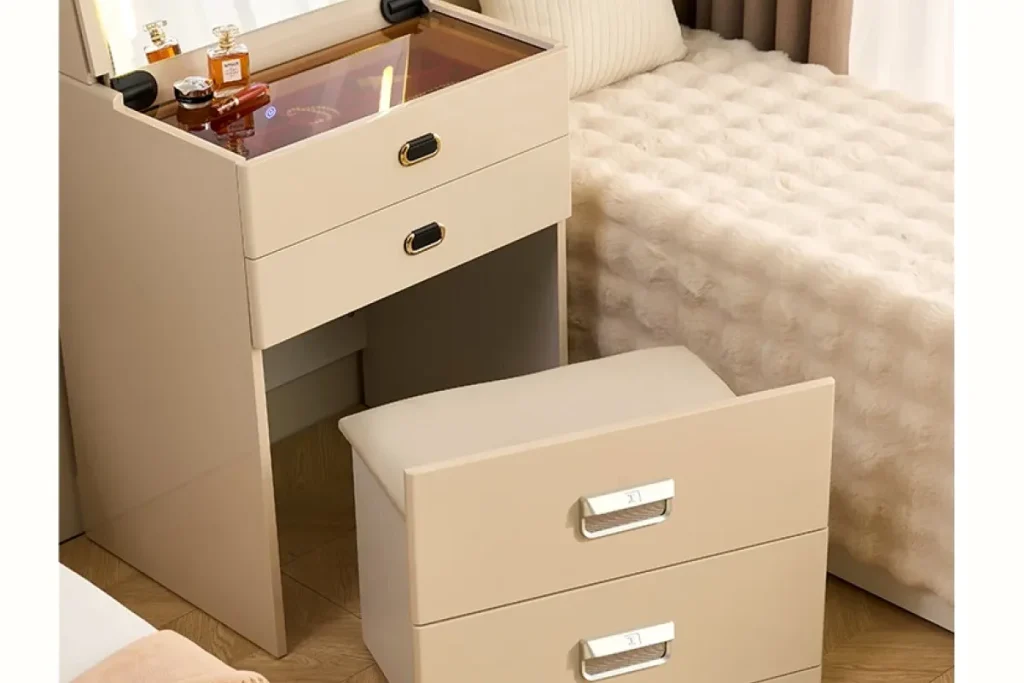
Traditional bedroom furniture often competes on appearance and set matching. A nightstand needs the right color, legs, handle, and proportion. Smart nightstands add another layer: utility. Buyers now ask what the product actually does beside the bed.
Common demand points include wireless charging, USB and Type-C ports, LED ambient lighting, sensor lights, Bluetooth speakers, lockable storage, hidden compartments, open shelf access, cable management, and compact dimensions for smaller bedrooms. Not every market wants all of these features. In fact, too many functions can make the product harder to explain, harder to service, and more expensive than the channel can accept.
The better question is not how many smart functions can be added. The better question is which functions match the buyer’s channel. An e-commerce listing may benefit from clear visible functions and simple assembly. A hotel or apartment project may care more about durable charging ports, replaceable modules, and consistent appearance. A retail buyer may want the product to feel modern without looking too technical.
Smart Features Change the Supplier Conversation
A normal nightstand quote usually starts with dimensions, board, finish, hardware, packaging, and quantity. A smart nightstand quote needs those details plus module specification, adapter requirements, cable routing, heat consideration, electrical testing expectations, spare parts, and the responsibility boundary between the furniture factory and the electronics supplier.
This is where sourcing teams need to slow down. A low price can hide weak electrical components, unclear module sourcing, poor internal wiring space, or packaging that does not protect the functional area. A good-looking sample may still be risky if the module is not stable, the surface scratches easily around the charging zone, or the factory cannot repeat the same layout in mass production.
For a more detailed category checklist, the earlier article Smart Nightstands and Connected Bedroom Furniture: What Buyers Should Check covers electrical modules, cable paths, heat, certifications, and product-development questions in more depth.
Design Still Matters, But It Has to Carry Function
Smart bedroom furniture can fail when the product looks like a feature list instead of a bedroom item. Buyers should check whether the charging zone feels natural, whether the LED light is useful rather than decorative, whether drawers remain easy to use, and whether the top surface still works as a bedside surface.
Small design decisions affect the user experience. A charging symbol placed too far back may be inconvenient. A bright light strip may look good in a photo but feel harsh at night. A speaker may add value in one market and feel unnecessary in another. A fingerprint lock may be useful for a private storage model, but it can also add service questions if the buyer has not planned spare parts or instructions.
Packaging and After-Sales Risk Become More Important
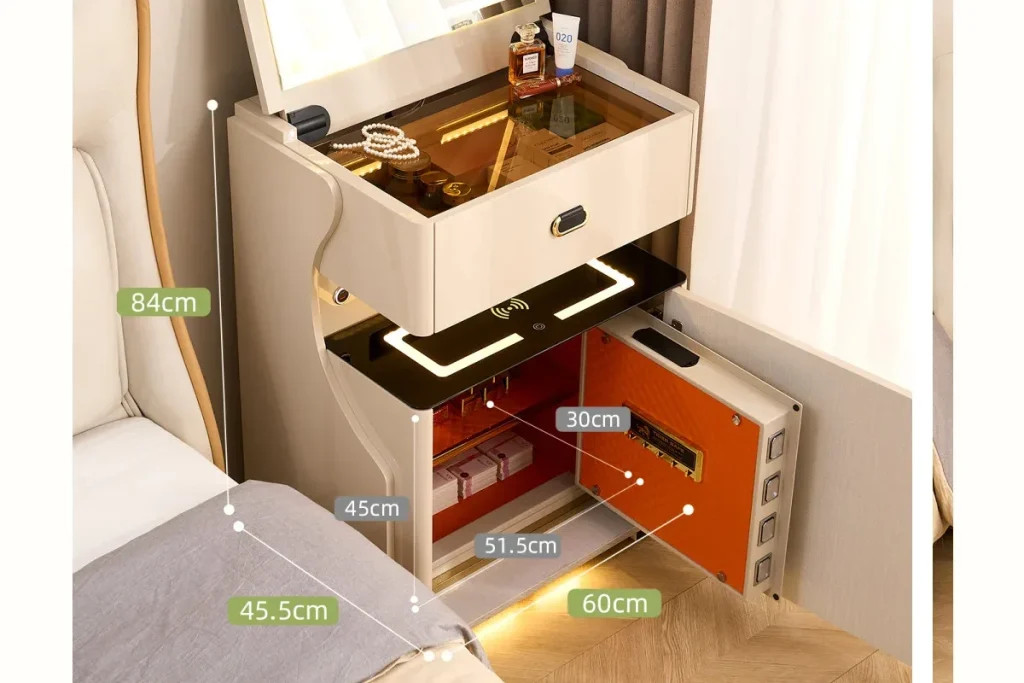
Smart nightstands are more sensitive in shipment than ordinary bedside cabinets. The product may include glass or high-gloss surfaces, lighting strips, electronic modules, power ports, cables, adapters, drawer mechanisms, and decorative parts. If the carton protects the cabinet but not the module area, the buyer can still face after-sales claims.
Packaging should be reviewed before mass production. Buyers should ask for photos of inner protection, accessory placement, adapter packing, instruction sheets, carton marks, and the position of any fragile or functional surface. The logic is similar to Bedroom Furniture Packaging and Loading Notes for Buyers, but the risk is higher because the product combines cabinet structure and functional modules.
MOQ, Samples, and Price Need a Different Review
A smart nightstand sample is not only a cabinet sample. It is also a function sample. Buyers should confirm whether the sample represents the final charging module, lighting color, power specification, drawer hardware, surface material, packaging method, and instruction plan. If the first sample only shows visual direction, it should not be treated as production approval.
MOQ can also change. Some suppliers may accept a lower cabinet quantity but require minimum purchasing quantities for charging modules, lighting parts, adapters, packaging labels, or special surfaces. This is why Furniture MOQ and Sample Orders: What Buyers Should Confirm Before Paying a Supplier is directly relevant to smart bedroom products.
When comparing quotes, buyers should separate the cabinet cost from the functional components. Two quotes may look close, but one may use a different module, weaker hardware, simpler lighting, or no spare-part plan. The framework in How Furniture Buyers Should Compare Supplier Quotes Before Sampling helps avoid comparing only the surface number.
A Practical Buyer Checklist
Before developing or sourcing smart nightstands, buyers can use a simple checklist:
- Define whether the product is for retail, e-commerce, apartment projects, hotel rooms, or private-label bedroom collections.
- Decide which smart functions are necessary and which are only decorative.
- Confirm charging module, USB or Type-C ports, adapter requirements, and target market power expectations.
- Check cable routing, heat, module access, and serviceability.
- Review drawer hardware, surface durability, lighting brightness, and top-surface usability.
- Confirm packaging protection for functional areas, accessories, instructions, and replacement parts.
- Separate sample approval into visual approval, functional approval, packaging approval, and mass-production approval.
- Ask whether the MOQ changes because of electronic components, cartons, labels, or special finishes.
Final Note
The move from nightstands to smart nightstands is not only a style update. It is a change in what buyers expect bedroom furniture to do. A bedside cabinet now has to compete with charging habits, small-space living, connected-home expectations, and the need for convenient storage.
For sourcing teams, the opportunity is real, but the category needs discipline. The strongest smart nightstand programs will not be the ones with the longest feature list. They will be the ones that combine useful functions, stable cabinet construction, clear packaging, realistic pricing, and supplier capability that can survive repeat orders.