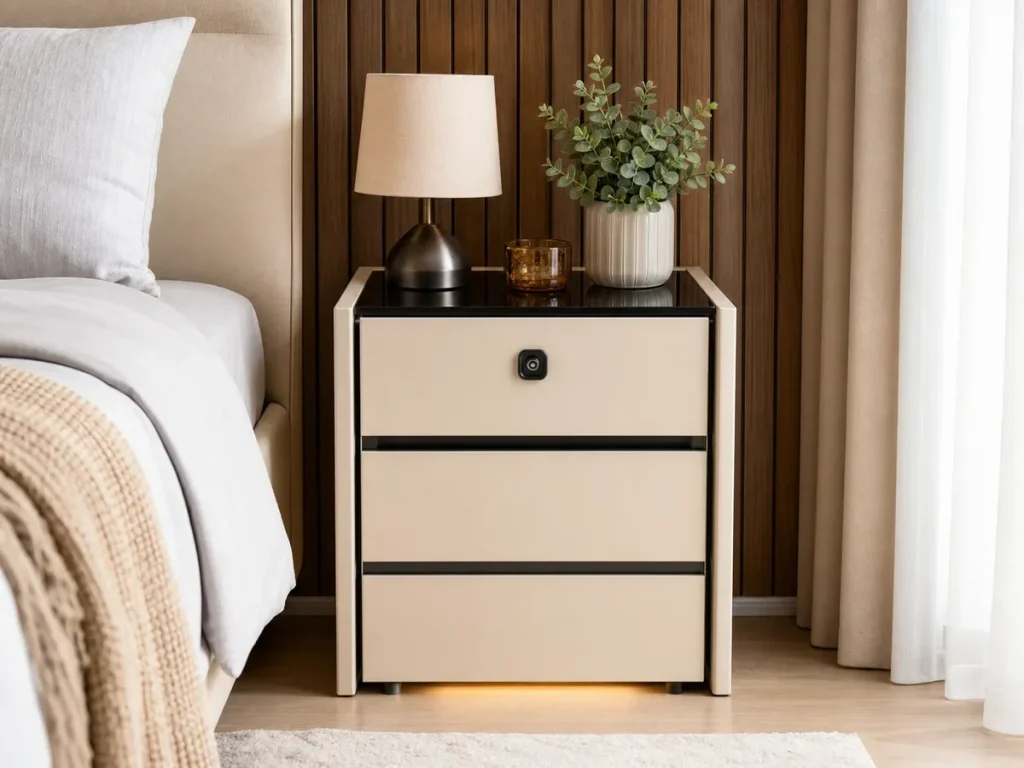
A nightstand can look well designed in a catalogue and still feel wrong beside the bed it is sold with. The issue is often proportion rather than finish: the top is too low to reach comfortably, too high against the mattress, too deep for the room, or too narrow for the functions the customer expects.
For furniture buyers, this is not a styling detail to leave until the end. Bed height, mattress thickness, bedside-table dimensions, drawer opening, cable access, and room circulation affect the product brief before a supplier starts a sample. Once a cabinet has been sampled, photographed, quoted, and packed, changing its dimensions is slower and more expensive.
Kuan Zhang’s view is that a nightstand should be measured as part of the sleep setting, not as an isolated cabinet. The buyer needs to know where the mattress surface sits, what people reach for at night, and how much room remains when drawers or doors are open.
Measure the Finished Bed, Not Only the Bed Frame
The useful reference point is normally the top of the finished mattress, rather than the height of the wooden or upholstered bed base. A thick mattress, topper, or platform construction can change the real bedside reach considerably. A nightstand approved beside one display bed may look low beside a deeper retail mattress or high beside a lower platform bed.
There is no single correct height for every market or bedroom style. The goal is a deliberate relationship between the usable top surface and the mattress. Buyers should decide whether the table is intended to sit close to mattress level, slightly below it, or noticeably above it for a particular storage or visual concept. That decision should be recorded in the specification rather than left to an image reference.
The article on product specification sheets before quotation explains why overall dimensions, tolerance expectations, drawer layout, and component positions need to be written down before factories quote different versions.
Height Changes the Everyday Reach
A bedside surface holds items people use while sitting or lying down: a lamp, glasses, a phone, water, medicine, a book, or a charging cable. When the top is too low, the user reaches down repeatedly. When it is too high, the cabinet can interrupt the visual line of the bed and become awkward from the mattress edge.
Functional features make this more sensitive. A wireless-charging area should be reachable without leaning far over the side. A lamp switch or touch-control panel needs a natural hand position. If the design has a rear power outlet, the cable route must still work after the bed is placed against a wall. Buyers considering connected products can compare this with the checks in power modules and cable management for smart nightstands.
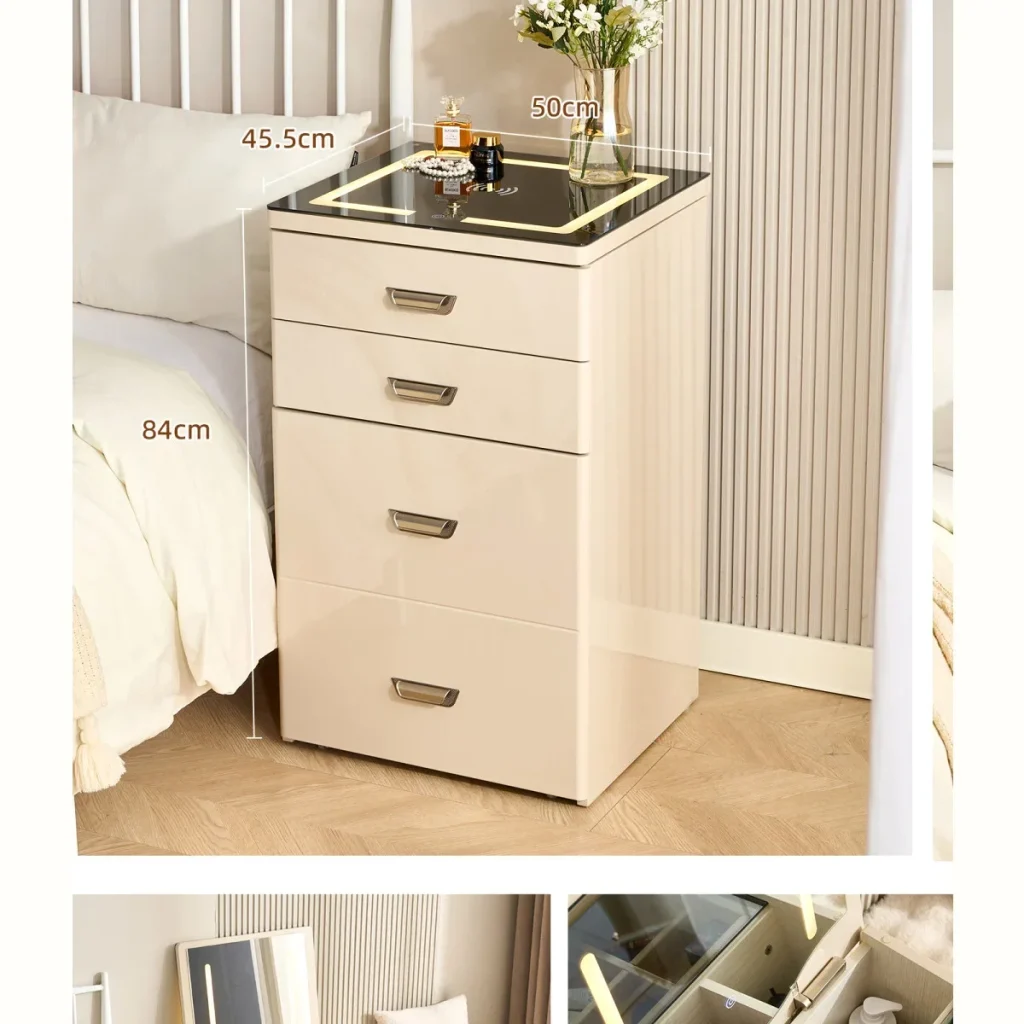
Width and Depth Must Fit the Room, Not Just the Product Photo
A wider nightstand gives space for a lamp, a book, and a charging zone. It can also make a modest bed look more substantial. But width takes space from the passage beside the bed, especially in apartments, guest rooms, and smaller secondary bedrooms.
Depth deserves the same attention. A deep cabinet may provide better drawer capacity, yet it can project past the bed, block a wardrobe route, or make a narrow room feel crowded. The buyer should check the cabinet against the planned mattress width, headboard position, wall line, skirting, and any curtain or closet clearance. A front-facing product image does not show these conflicts.
One practical sample review is to mark the proposed width and depth on the floor beside a real bed. It quickly shows whether a drawer can open without conflicting with the bed, a bench, a wardrobe, or the main walking route. This simple check often identifies problems earlier than a long email discussion.
Storage Height Is a Different Product Decision
Some buyers need a compact, low bedside table. Others want a taller storage-led cabinet for small apartments, guest rooms, or customers who keep more personal items close to the bed. These are different product jobs, and they should not be treated as a small dimensional variation of the same model.
A taller unit can increase drawer volume and create a stronger vertical feature in the room. It may also create a mismatch if it rises far above the mattress or competes visually with the headboard. The room needs enough clearance for drawers, doors, or flip-up sections, and the product needs a stable base that suits its height and intended load.
For range planning, it is often clearer to offer a deliberately compact model and a deliberately storage-focused model than to stretch one cabinet until it serves neither use well. The article on smart nightstand SKU mix and price ladders offers a useful approach to separating product roles within a range.

Drawer and Door Clearance Need Real-World Testing
Height and depth decisions affect movement. A drawer can appear fine on a static drawing but become inconvenient when it opens close to the bed. A side door may need space that does not exist in a narrow room. A tall drawer stack can place the most-used compartment too low or too high for normal bedside use.
During sampling, buyers should place the nightstand beside a bed at the intended distance, then test every opening with the bed dressed as it would be in a home or showroom. Pull drawers from the center and from each side. Confirm that handles, fingers, and forearms have enough room. If the item will be sold online, this testing matters because the customer will assemble the room around a real bed rather than a staged photo.
The broader guidance in nightstand drawer slides and hardware checks is relevant here. Smooth runners and stable gaps are important, but the drawer also has to work in the intended bedroom footprint.
Keep the Dimensions Consistent Across Versions
Dimension mistakes sometimes begin when a supplier adapts one design for several markets. A cabinet may become wider for extra storage, taller for a different bed style, or deeper to accommodate an electrical module. Those changes can alter drawer proportions, leg position, carton size, hardware length, and the visual balance of the front.
Buyers should ask for a revised drawing whenever the height, width, depth, board thickness, base, or function changes. The change should be reviewed against the matching bed and bedroom set, not approved from a cropped product image. This is particularly important when a product line includes ordinary nightstands and smart versions that need extra internal space.
Factory execution matters as well. If the approved dimensions depend on tight drawer gaps, accurate drilling, or a particular base height, those points need to be controlled during production. The article on factory capability checks before order explains why a good sample does not by itself prove consistent batch output.
A Buyer Checklist Before Sampling
- Measure the top of the finished mattress, not only the bed frame or headboard.
- Define the intended relationship between mattress height and usable nightstand top height.
- Check width and depth against passage space, wardrobe clearance, walls, curtains, and skirting.
- Test drawer, door, and flip-up opening clearance beside a real or accurately marked bed position.
- Confirm the reach to lamps, charging areas, switches, shelves, and the first frequently used drawer.
- Separate compact bedside-table requirements from tall storage-cabinet requirements.
- Request an updated drawing whenever dimensions or internal functions change.
- Review the final product dimensions together with carton size, loading plan, and retail assembly expectations.
Final Note
Good nightstand proportion is easy to overlook because it is rarely the headline feature. Yet it shapes how the customer reaches, stores, moves, and feels in the bedroom every day. A product that fits the bed and room well can make a simple design feel considered. A cabinet with the wrong height or depth can create a complaint that no upgraded finish will solve.
Before sampling, buyers should turn the bed, mattress, room, and nightstand into one review. Clear measurements and a real-use test give the supplier a better brief and give the finished range a better chance of working outside the showroom.