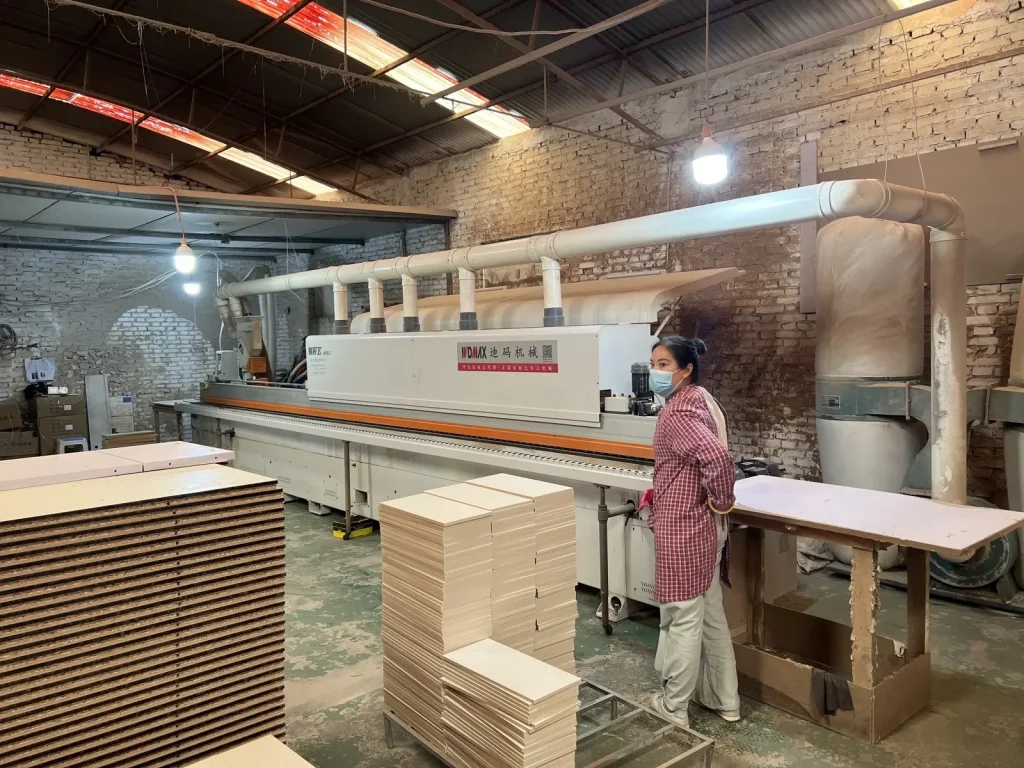
Nightstand materials are often described in a few words: MDF, particleboard, plywood, wood veneer, or solid wood. Those names are useful starting points, but they do not tell a buyer enough to approve a price. A bedside cabinet can look similar on a product page while using different core materials, thicknesses, edge treatments, backing panels, drawer parts, and fixing methods.
The right material is not automatically the most expensive one. It is the one that fits the product position, finish, expected use, construction, price target, and route to market. Buyers get into trouble when the quote says only “wood board” or “MDF cabinet” while the supplier and buyer are picturing different things.
Kuan Zhang’s view is that board material should be reviewed component by component. The top panel, side panel, drawer front, drawer bottom, back panel, shelf, leg block, and rear cable area do not always need the same construction. What matters is that the supplier can explain the selection and that the approved sample matches the written version.
Start With the Job of Each Component
A nightstand top carries lamps, phones, water, books, and sometimes a charging device. The side panels hold the cabinet square. Drawer fronts define the visible finish. Drawer bottoms take repeated loading. Rear panels may include cable holes or sit close to a wall. A shelf or open compartment may be touched more often than the cabinet exterior.
That is why a material decision should not be made only from a front-facing image. Buyers should ask for a simple component list that states the board type, thickness, surface treatment, edge treatment, and any special construction around hardware, legs, or electrical cut-outs. The product specification sheet before quotation is the right place to make this visible before factories build different assumptions into their prices.
MDF Is Often Chosen for a Smooth Finished Surface
MDF is commonly used where a smooth painted, wrapped, or machined surface is needed. It can provide a consistent face for certain finishes and shaped details. However, a buyer still needs to check the panel thickness, the quality of machining, the finish system, edge protection, and how screws or fittings are placed. Calling a cabinet “MDF” does not answer these questions.
For a painted drawer front or a routed design detail, the visible result may depend as much on preparation and finishing as on the board itself. For a cabinet that will be flat-packed, repeatedly assembled, or fitted with heavy hardware, the fixing position and local reinforcement matter as well. The material should be judged together with the construction, not as a label on its own.
Particleboard Can Suit a Well-Defined Value Product
Particleboard is widely used in panel furniture and can be a practical choice for value-oriented bedside ranges when the product is designed around it properly. Panel thickness, density, surface finish, edge treatment, drilling accuracy, and fastening details all affect the final result. A good-looking laminate surface does not show what happens at a cut edge, a cam-lock point, or a drawer-runner screw position.
Buyers should pay particular attention to areas that will be drilled, exposed, or repeatedly loaded. These include hinges, drawer-slide screws, legs, connectors, wall-facing cable cut-outs, and edges close to the floor. If a supplier proposes a lower-cost board option, ask which components change and how the change affects the cabinet’s assembly, fixing, and expected customer use.
Plywood and Solid Wood Need Their Own Questions
Plywood is made from layers rather than a single uniform board, so the face, core, thickness, edge appearance, and machining quality need to be reviewed. It may be selected for particular construction needs, but “plywood” is not one fixed quality level. A buyer should see the relevant sample and confirm where it is used rather than assuming that the name alone defines the performance.
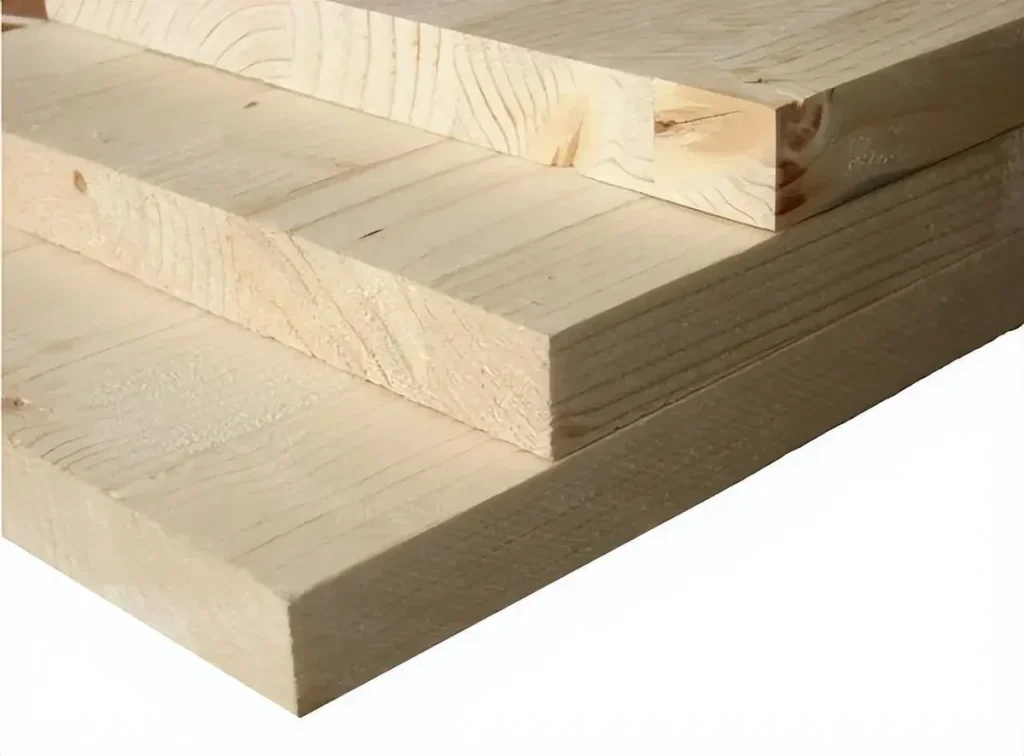
Solid wood introduces a different set of decisions: species, visible grain, colour variation, joints, component size, and the degree of natural variation the market will accept. It may be used on legs, handles, trim, or visible framing even when the cabinet body uses an engineered board. If a supplier uses the word “wood” in a quotation, the buyer should ask whether it means solid wood, veneer, wood-look paper, or a wood-grain surface finish.
Veneer, Paper, Laminate, and Paint Are Not Interchangeable Descriptions
The surface is what the customer sees first, but surface language can easily become vague. Veneer is a real wood face layer; a wood-grain paper or film creates a printed visual; laminate systems vary by construction; paint covers the board differently again. Each option can fit a particular product, but the buyer should know what the sample represents before approving catalogue photography or a selling price.
A useful review includes the face, the edge, the inside surface, the underside, and any area around a handle or cable hole. If the cabinet has an integrated light strip, wireless charging area, mirror, or control panel, the material and finish around that opening need separate attention. The article on surface durability for smart nightstands adds practical checks for frequently touched and functional surfaces.
Edge Treatment Often Tells the Real Story
Edges are where a material specification becomes visible in daily use. They are close to cleaning, movement, drawer impact, and accidental knocks. A clean edge can make a modest cabinet look controlled; a poor edge can make a more expensive surface look unfinished.
Buyers should inspect corners, the lower edge near the floor, internal shelves, cut-outs, and the rear of the cabinet. Look for colour consistency, glue marks, sharpness, gaps, lifting, uneven trimming, and whether the edge treatment follows the approved sample. The question is not only “is there edge banding?” but also “which edges receive it, how does it look, and how will it be controlled across the batch?”
Material Selection Affects Hardware and Assembly
Drawer runners, handles, legs, hinges, and knock-down connectors need a stable construction around them. A wider or deeper drawer, for example, can put more demand on the drawer box and fixing points than a shallow decorative drawer. A smart nightstand may also need room for cables, power modules, or a control panel without weakening the structure around the opening.
This is why material and hardware should be reviewed together. The guide to nightstand drawer slides and hardware explains how movement, screw fixing, alignment, and repeated use belong in the same sample review. A stronger-looking slide cannot correct a weak or poorly detailed fixing area behind it.
Do Not Approve From a Single Finished Face
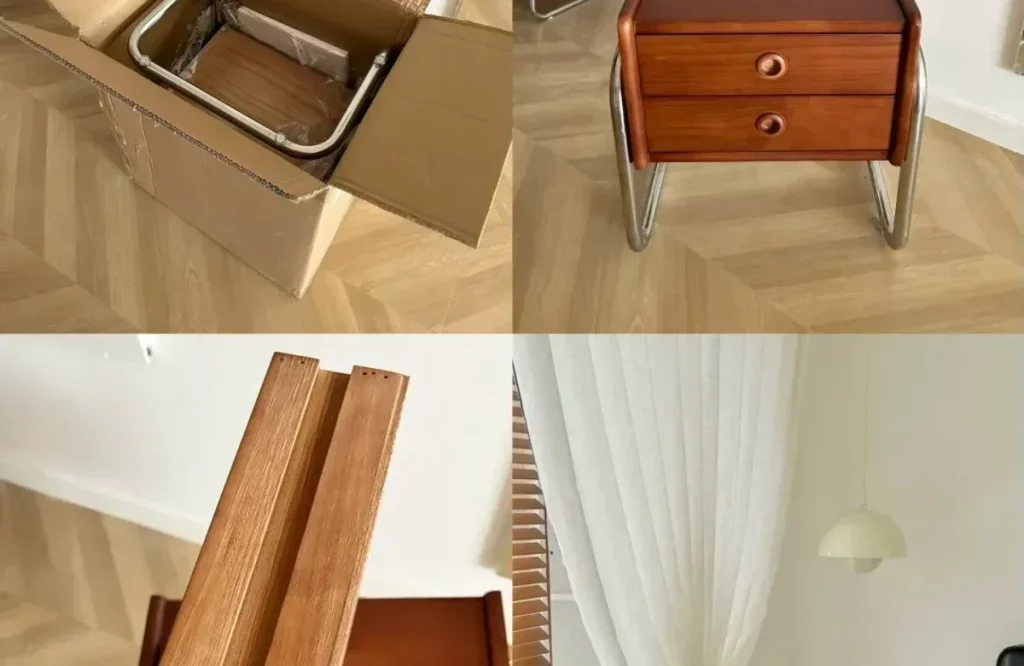
A polished sample photograph is useful for design approval, but it is not enough for material approval. Ask to see the cabinet interior, unfinished or covered edges where appropriate, rear construction, drawer box, back panel, underside, and any locations where hardware is fixed. Where a factory proposes an alternative, request the same views for both versions.
Kuan normally treats unexplained substitutions as a version change. A change in board type, thickness, drawer bottom, rear panel, surface system, or edge treatment can affect price, weight, carton design, hardware fixing, and customer expectations. The supplier should identify the change before production, rather than allowing it to appear during a final inspection.
The article on factory capability checks before order is relevant at this stage. Consistent panel processing, drilling, finishing, and assembly are what turn an approved material choice into repeatable batch output.
What Buyers Should Confirm Before Approving a Quote
- The board type, thickness, and surface treatment for each main cabinet component.
- Which parts are solid wood, veneer, plywood, MDF, particleboard, or another material system.
- The intended finish on the face, edges, interior, underside, and rear of the cabinet.
- How drawer slides, hinges, handles, legs, and connectors are fixed into the specified construction.
- How cable holes, charging areas, lights, mirrors, or control-panel cut-outs are reinforced and finished.
- Which sample details are the reference for edge appearance, corners, drilling, and internal construction.
- Whether any alternative board or finish changes require written approval before production.
- What documentation or testing is required for the intended market, rather than assuming a generic claim covers every destination.
Final Note
Material selection is not a contest between board names. It is a practical product decision that connects finish, structure, price, hardware, packaging, and the way a bedside cabinet is used. A clear, component-level brief gives buyers a fairer quote comparison and gives factories a better basis for sampling.
Before approving a nightstand price, ask to see what sits behind the finished face. The material, thickness, edges, internal parts, and fixing points should all be clear enough that the production version has nowhere to hide a surprise.