Smart nightstands for hotels and serviced apartments should not be evaluated in the same way as a home retail product. A household buyer may enjoy extra functions and spend time learning them. A hotel guest expects the bedside area to be obvious, reliable, clean, and easy to use immediately.
That changes the buying logic. The best project product is not always the model with the most functions. For hotel rooms, serviced apartments, rental suites, and long-stay units, the better product is often the one that combines useful charging, simple lighting, durable surfaces, replaceable parts, and clear installation control.
Kuan Zhang’s view is that project buyers should start from the room operation, not the product brochure. A smart nightstand must work for the guest, the housekeeping team, the maintenance team, the project installer, and the buyer who may need replacement units two years later.
Hotel Use Is Different From Home Use
In a private bedroom, the same person uses the nightstand every day. In a hotel or serviced apartment, many guests use the same furniture with different habits, devices, expectations, and levels of care. That means the product must be easier to understand and harder to misuse.
A wireless charging mark that is too subtle may confuse guests. A touch button with several hidden modes may cause complaints. A Bluetooth speaker that keeps old pairing records may create privacy and reset problems. A soft light that looks attractive in a photo may become annoying if it turns on too easily at night.
The earlier article on smart nightstands and connected bedroom furniture explains the category at a broad level. This article focuses on the stricter requirements created by shared guest rooms and project procurement.
Start With the Room Layout
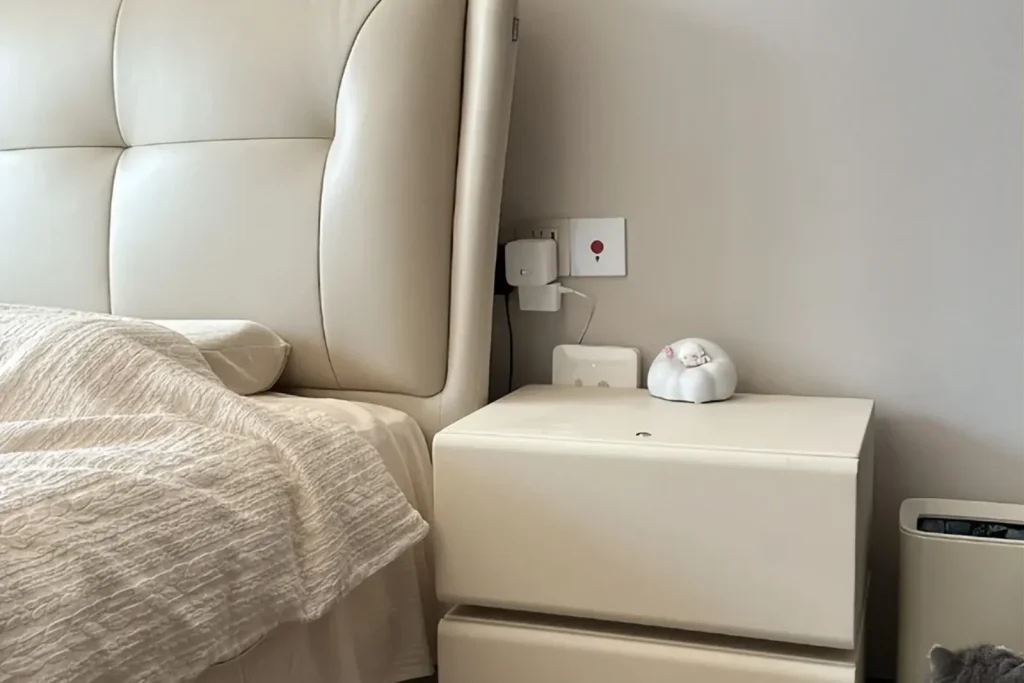
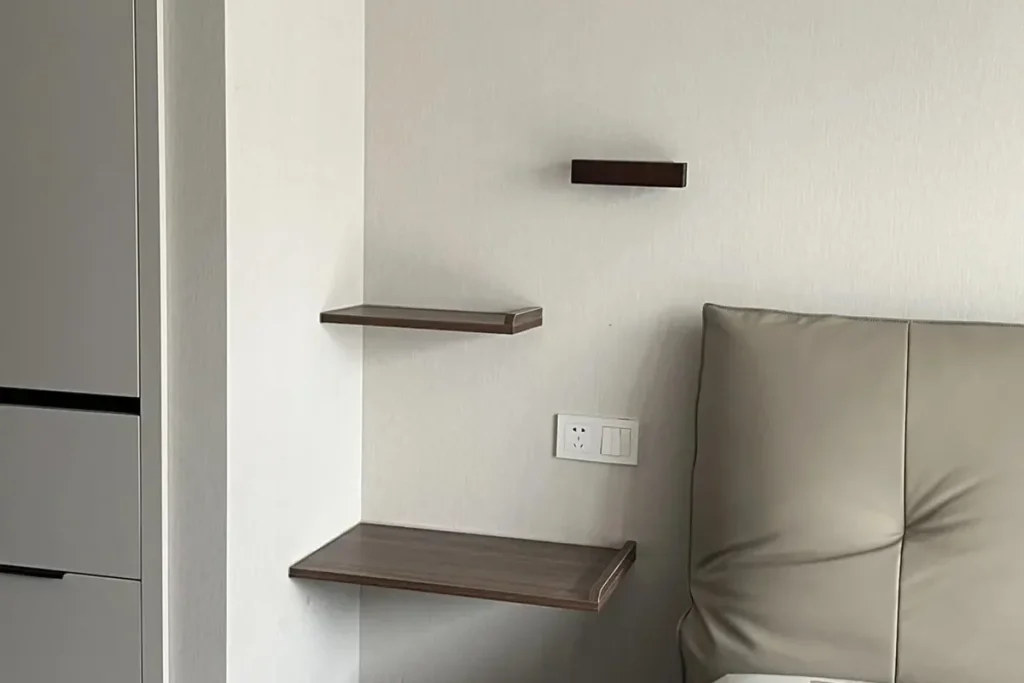
The nightstand must match the bed height, headboard structure, outlet position, switch location, wall panel, floor clearance, and housekeeping path. A product that works well in a showroom may be awkward when placed beside a hotel bed with fixed wall sockets or a built-in headboard.
Project buyers should check where the guest’s phone will sit, where the power cable exits, whether the module can be reached for service, and whether the drawer opens without hitting bed frames, curtains, luggage, or wall details. If the room uses fixed wiring or a specific plug standard, the supplier needs that information before quoting.
This is where a mock-up room matters. The buyer should not approve the product only from a sample in a factory office. The nightstand should be tested beside the actual or simulated bed wall, with the expected mattress height, outlet location, lighting plan, and cleaning movement.
Simple Controls Beat Complicated Features
Hotel guests should not need a manual to use a bedside product. For project use, the control logic should be visible and limited. A guest should understand how to charge a phone, turn a light on or off, and use basic storage without calling reception.
That does not mean smart functions should be removed. It means the useful functions should be selected carefully. Charging ports, a clear wireless charging zone, warm night lighting, and a simple power connection can make the room feel more modern. Too many modes, hidden long-press operations, loud startup sounds, or confusing touch icons can create more trouble than value.
The articles on touch controls and LED lighting are useful references. In hotel rooms, those features must be judged by guest clarity and maintenance risk, not only by visual appeal.
Charging Must Be Durable and Replaceable
Charging is one of the clearest smart nightstand features for hotels and serviced apartments. Guests usually understand USB, Type-C, and wireless charging faster than more decorative functions. But charging modules are also high-contact components.
Project buyers should ask whether the ports are easy to access, whether cables are protected from pulling, whether the module can be replaced without replacing the whole cabinet, and whether the supplier can provide spare modules later. If the project uses many rooms, a small module failure can become a repeated maintenance issue.
The article on power modules and cable management covers the component side. For hotels, the same checks should be connected to room installation, housekeeping, guest turnover, and replacement planning.
Surfaces Need Cleaning and Guest-Wear Testing
Hotel furniture is cleaned frequently and used by people who may not treat it carefully. A smart nightstand surface may face cups, cosmetics, phone cases, keys, luggage, cleaning cloths, disinfectant, and repeated guest contact. A delicate finish can become a complaint even if the smart function works well.
Buyers should test fingerprints, cleaning marks, scratch visibility, edge wear, and moisture around the top surface, drawer front, charging area, and light strip. The surface should also be checked under guest-room lighting, because LED reflection and warm bedside lighting can reveal scratches or uneven gloss.
The article on surface durability in smart nightstands explains this in more detail. For hotel and apartment projects, the cleaning team should be considered part of the product-use environment.
Maintenance Access Should Be Designed Early
Project buyers should ask a practical question: if the charging module, light controller, adapter, drawer runner, handle, or lock fails, what exactly happens? Can the maintenance team replace a part in the room? Does the cabinet need to be removed? Are the components marked clearly? Are spare parts packed and labeled for the project?
A home customer may accept a replacement shipment. A hotel or serviced-apartment operator may need a fast room-level fix. Every hour of maintenance affects room availability, guest satisfaction, and operating cost.
This connects with after-sales planning for smart nightstands. In project furniture, spare parts are not just a customer-service detail. They are part of the operating plan.
Batch Consistency Is More Important Than Novelty
Hotel projects often require many rooms to look consistent. If the nightstand finish, light color, drawer gaps, handle position, or charging module appearance changes between batches, the issue becomes visible across the property.
Buyers should approve color samples, finish panels, hardware references, light color, adapter type, module position, packaging marks, and replacement-unit assumptions before mass production. If the project may reorder later, the supplier should explain how the same finish and component configuration will be controlled.
The broader article on hotel and project furniture procurement is relevant here. Smart nightstands add electrical components to the normal project furniture need for finish consistency, mock-up approval, delivery coordination, and replacement planning.
Guest Privacy and Reset Logic Matter
Some smart features create privacy or reset questions. Bluetooth pairing, speaker functions, lockable drawers, app-based controls, memory settings, and device names may be acceptable in a private home but awkward in shared accommodation.
Buyers should avoid features that create unclear ownership of data, pairing history, or guest settings unless the reset process is simple and the operator is prepared to manage it. For many hotel projects, charging and lighting are safer and clearer than functions that require pairing or personal configuration.
This does not mean hotels cannot use advanced features. It means every feature should have an operating answer: how it is reset, who handles it, how a guest understands it, and what happens when it fails.
Buyer Checklist
- Test the smart nightstand in a mock-up room, not only as a loose sample.
- Confirm bed height, wall outlet position, headboard structure, drawer clearance, and cleaning path.
- Choose guest-facing functions that are easy to understand without a manual.
- Check whether charging modules, adapters, light controllers, and drawer hardware are replaceable.
- Test surface cleaning, scratches, fingerprints, and edge wear under guest-room lighting.
- Prepare spare parts, labeling, and maintenance guidance before mass delivery.
- Control finish, light color, module position, and hardware consistency across batches.
- Avoid features that create pairing, reset, privacy, or guest-confusion problems unless the operating process is clear.
Final Note
Smart nightstands can improve hotel and serviced-apartment rooms when they solve real guest problems: charging, soft lighting, convenient storage, and a cleaner bedside experience. They become risky when they add complexity without an operating plan.
For project buyers, the goal is not to buy the most impressive smart nightstand. The goal is to approve a product that fits the room, survives repeated use, can be cleaned and serviced, and remains consistent across many units and future replacement orders.