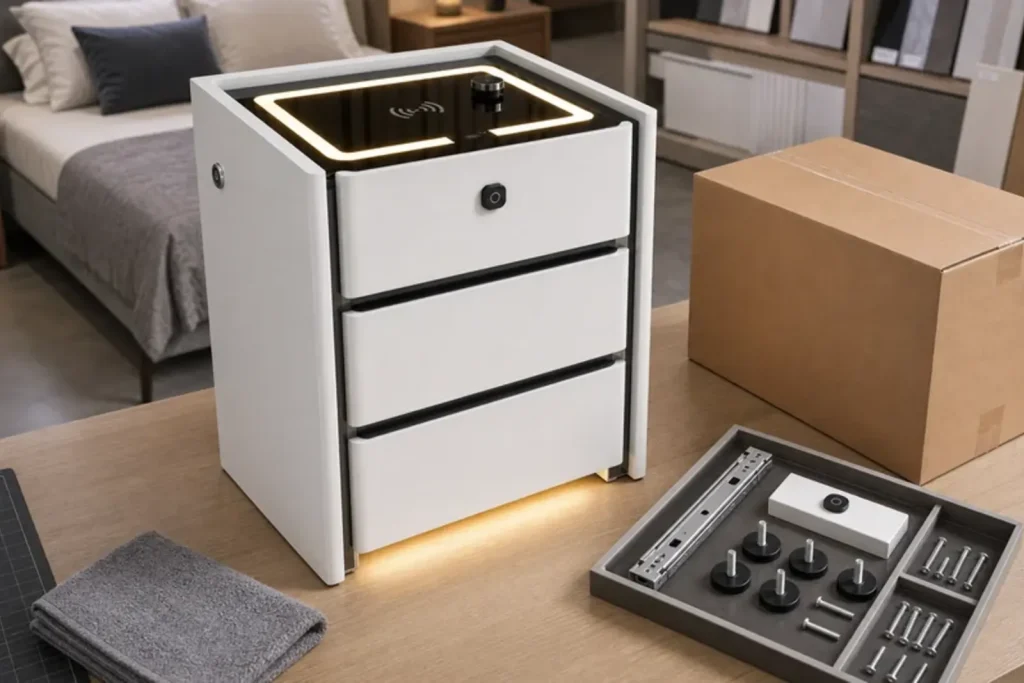
Smart nightstand development often starts with attractive functions: charging, lighting, Bluetooth audio, touch controls, lockable storage, or a compact vanity feature. Those features help a product stand out. They also create after-sales questions that a normal bedside cabinet does not usually have.
If a drawer runner becomes loose, a light does not turn on, an adapter is missing, a touch panel stops responding, or a customer cannot reset a lock, the dealer needs a clear answer. Without that plan, one small component can turn into a full product return.
Kuan Zhang’s view is that smart nightstands should be designed with service in mind from the beginning. A buyer should not wait for the first complaint to ask which parts are replaceable, who supplies them, where they are packed, and how the dealer explains basic troubleshooting.
Why After-Sales Planning Matters More for Smart Nightstands
A standard nightstand usually has a limited set of service issues: damaged panels, scratched finish, missing screws, drawer runner problems, handle alignment, or carton damage. A smart nightstand can still have all of those issues, plus electrical modules, lighting strips, control panels, adapters, cables, sensors, speakers, locks, mirrors, and instruction problems.
That does not mean the category is too risky. It means the buyer needs a more complete product plan. The item should not only look good in a sample photo. It should also be manageable after delivery, especially for dealers, importers, e-commerce sellers, rental-unit suppliers, and project buyers that may handle many units at once.
The earlier article on smart nightstands and connected bedroom furniture explains why modules, cable paths, heat, and service access matter. This article focuses on what happens after the product reaches the customer or dealer warehouse.
Start With a Spare Parts List
The spare parts list should be written before mass production, not after the first problem appears. For a smart nightstand, that list may include drawer runners, handles, screws, adjustable feet, LED strip, light controller, touch panel, charging module, Type-C board, adapter, cable, speaker module, lock face, backup key, mirror hinge, instruction sheet, and accessory bag.
Not every part needs to be stocked in large quantity. The point is to identify which parts are likely to be needed, which parts are difficult to source later, and which parts can be replaced without destroying the cabinet. A buyer does not want to learn during a claim that the module was glued into the panel and cannot be replaced separately.
This connects directly with power modules and cable management in smart nightstands. If adapters, cables, and ports are not defined clearly, the spare-parts plan will also be unclear.

Module Access Is a Design Decision
A smart feature is easier to sell when it looks seamless, but a fully hidden module can be difficult to service. Buyers should ask how the module is installed. Is it screwed into a removable plate? Is it clipped into a plastic housing? Is it bonded under glass? Does replacing it require removing the top panel, drawer box, mirror lid, or back panel?
The answer affects real cost. A replaceable charging board or LED controller may solve a small claim quickly. A non-serviceable module may force the dealer to replace the entire cabinet. For e-commerce channels, that can mean high freight cost and negative reviews. For project buyers, it can mean site maintenance problems across many rooms.
The article on touch controls in smart nightstands is relevant here because a control panel is also a service part. It should be attractive, but it should also have a clear replacement path if the product is sold in volume.
Manuals Should Answer Real Customer Questions
A smart nightstand manual should not only show assembly. It should explain how to use the functions, what is included in the carton, where the adapter connects, how to reset a feature, how to clean the functional surface, and when the customer should contact the seller.
Basic troubleshooting can prevent unnecessary returns. For example: what to check if charging does not start, what to do if the light does not turn on, how to reset a lock, how to reconnect a speaker, how to avoid covering ventilation, and how to identify whether an adapter or module is missing.
Good instructions are not long for the sake of being long. They are specific. The manual should match the exact product version, not a generic smart furniture note. If the product has changed module type, port position, adapter, lock method, or light controller, the manual should change too.
Dealer Training Reduces Repeated Claims
Dealers need short, practical answers. A showroom salesperson should know how to demonstrate the main function without guessing. An online customer-service team should know which photos or videos to request when a customer reports a problem. A warehouse team should know where accessories are packed and how to check a returned item before restocking it.
This is especially important when the dealer sells several smart nightstand models. A wireless charging model, a lockable model, a speaker model, and a lighted mirror model can look similar in photos but use different modules and instructions. If customer-service staff cannot identify the version, the wrong answer may be sent to the customer.
The dealer opportunity is practical confidence. A product with a visible service plan feels more professional. Buyers and retailers can promote smart functions more comfortably when they know what happens if something fails.
Return Checks Should Be Planned Before Shipment
Returned furniture is expensive because it is bulky, easily scratched, and often difficult to repack. Smart nightstands add another question: is the problem with the cabinet, the accessory, the customer setup, or the module itself?
A simple return checklist can help. The warehouse can check carton condition, accessory bag, adapter, cable, port area, light function, control panel, drawer movement, lock reset, visible damage, and missing instruction sheets. This does not solve every problem, but it prevents many units from being written off too quickly.

Packaging Should Support Service, Not Only Delivery
Packaging is usually discussed as a way to prevent damage during shipment. For smart nightstands, it also supports after-sales handling. Accessories should be easy to identify. Manuals should not be hidden under foam. Spare keys, adapters, cables, and small hardware should have fixed positions so the dealer can confirm quickly whether something is missing.
For products likely to be returned through e-commerce or dealer warehouses, repacking matters. If the carton can be opened and closed without destroying every protection layer, the dealer has a better chance of inspecting and reselling an undamaged unit. If the accessory bag is loose and the foam breaks immediately, every return becomes harder to manage.
The broader packaging points in bedroom furniture packaging and loading checks are useful background. Smart nightstands simply add more parts that must stay identifiable and protected.
Version Control Prevents Confusion
Smart nightstands often change during development. A supplier may upgrade a charging module, change a touch panel, replace an adapter, revise a lock, adjust LED color, or modify a cable route. If the buyer does not track those changes, the spare parts and manual may no longer match the production batch.
Version control does not need to be complicated. The buyer can record the approved module photo, part code, supplier name, adapter specification, wiring photo, manual version, and packaging photo. When the next order is placed, those details help confirm whether the supplier is quoting the same product or a changed one.
The framework in furniture product specification sheets before quotation helps here. A smart feature should be specified as a product component, not only shown as a marketing phrase.
Factory Capability Still Matters
A supplier that can build a good sample is not automatically ready for after-sales support. Buyers should ask whether the factory can label parts, keep module records, provide spare units, pack accessories consistently, and explain the replacement method. If the supplier uses outside electronic components, the buyer should know who is responsible for continuity.
Kuan Zhang usually checks whether the factory can describe the problem path. If a port fails, what should the dealer check first? If a lock cannot open, what is the backup route? If an LED strip fails, can the controller and strip be separated? If a panel arrives scratched, is there a replacement panel or only a full-unit claim?
The article on furniture factory capability checks before order is relevant because service planning is part of factory capability, not just an afterthought.
Buyer Checklist
- Create a spare parts list for hardware, modules, adapters, cables, locks, lights, panels, and accessory bags.
- Confirm which parts can be replaced without damaging the cabinet.
- Record approved module photos, part codes, supplier assumptions, and manual version.
- Check that the manual explains function use, reset steps, accessory list, and basic troubleshooting.
- Prepare dealer training notes for showroom demonstration, customer questions, and return checks.
- Define how returned units should be inspected, repacked, repaired, or written off.
- Pack accessories in fixed positions so missing parts can be identified quickly.
- Ask the supplier how future orders will keep the same module, adapter, lock, or control-panel version.
Final Note
After-sales planning is not the most exciting part of smart nightstand development, but it protects the business behind the product. A dealer can sell smart functions more confidently when spare parts, manuals, packaging, version control, and return checks are already planned.
For buyers, the goal is not to avoid every possible problem. The goal is to make common problems manageable. A smart nightstand with a practical service plan is easier to scale than a more impressive sample that cannot be repaired, explained, or repeated after the first shipment.