LED lighting is one of the most visible smart nightstand functions, but it is often treated too casually. A small strip light can look attractive in a product photo, yet the real question is whether the lighting improves night use, helps the dealer explain the product, and can be specified consistently for repeat orders.
This angle is different from wireless charging, Bluetooth speakers, or lockable storage. Those features solve power, audio, or private-item needs. Lighting changes the way the user sees and moves around the bedside area. It can make a drawer easier to find at night, create a warmer bedroom atmosphere, guide a person stepping out of bed, or support a lighted-mirror routine before sleep.
Kuan Zhang’s view is simple: LED lighting should start with purpose, not decoration. A buyer should be able to say what the light is for, where it is placed, how bright it should be, how it is controlled, and what happens if a customer needs service later.
What LED Lighting Actually Changes
A traditional nightstand is judged by size, finish, drawer layout, and price. A smart nightstand with lighting adds a new user moment. When the bedroom is dark, the customer can find the cabinet, open a drawer, check a phone, or move around the bed without turning on a strong ceiling light.
That does not mean every lighted nightstand is useful. If the light is too cold, too bright, placed at eye level, or difficult to switch off, it can feel uncomfortable. If the LED strip is only added to make the product look futuristic, the feature may help the first photo but disappoint the daily user.
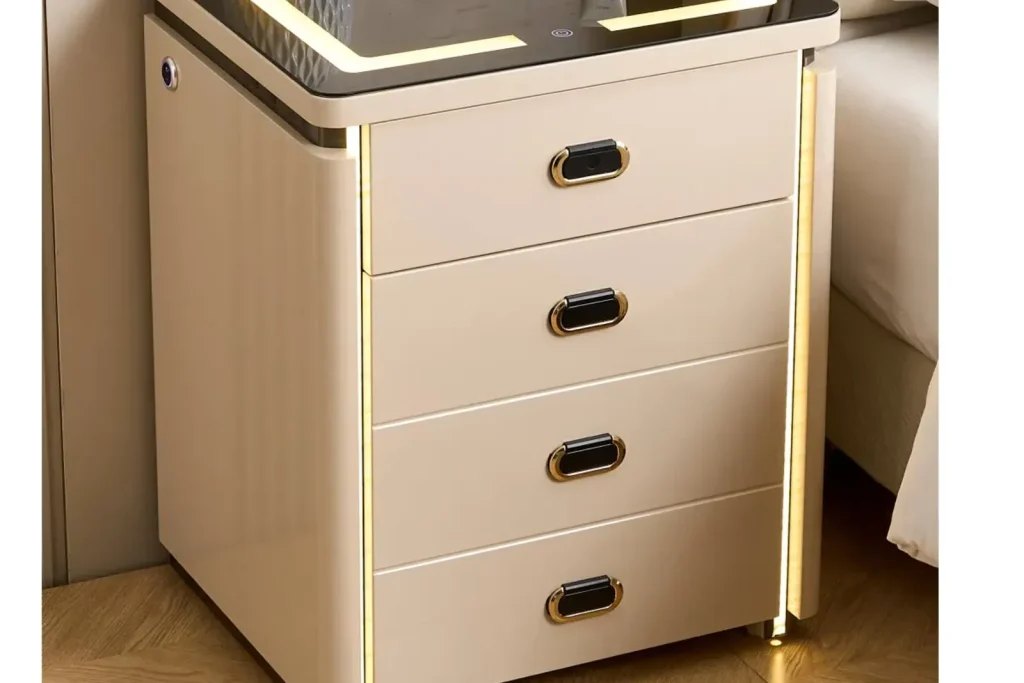
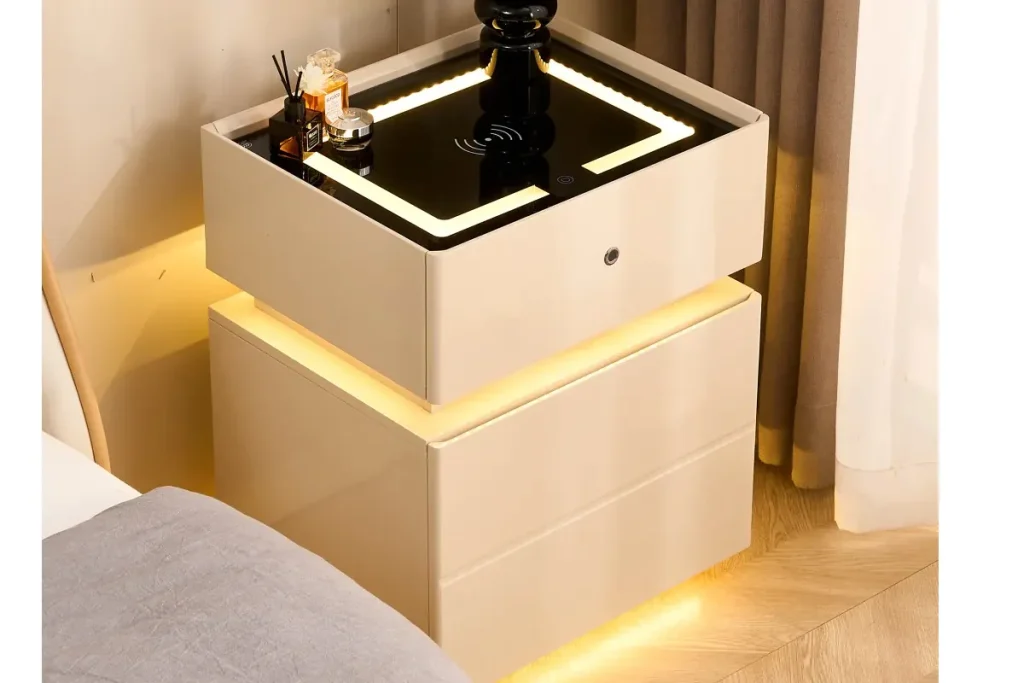
The better approach is to connect the lighting position to a real task. Side lighting can outline the cabinet. Under-cabinet lighting can guide the floor area. Drawer lighting can help the user find small items. A mirror light can support grooming or a compact vanity function. Accent lighting can make a showroom display stronger, but it still needs a control method that makes sense in a bedroom.
Why Dealers Care About a Lighting Feature
For dealers, lighting is easy to demonstrate. A customer may not immediately understand a charging module specification, but they can see a warm side light or sensor floor glow in a few seconds. That makes LED lighting useful for showrooms, short videos, online product pages, and bedroom collection displays.
Lighting also helps create a product ladder. A standard nightstand may focus on storage and finish. A middle model can add warm side lighting or under-cabinet lighting. A higher model can combine lighting with charging, a lockable drawer, a speaker, or a lighted mirror. The dealer can then explain value through visible functions instead of only comparing material and price.
The opportunity is strongest when the feature feels calm and practical. A warm light that helps the user move at night is easier to sell than a harsh decorative strip. For family bedrooms, apartments, guest rooms, and serviced units, the selling point is not only visual effect. It is convenience without adding another lamp or device to the bedside surface.
What Buyers Should Specify Before Sampling
LED lighting should be written into the product specification, not left to a supplier’s default choice. The buyer should define the lighting purpose, position, color temperature, brightness range, switch type, sensor logic, dimming behavior, power input, cable routing, and replacement method.
Color temperature needs particular care. A very cool light can make a bedroom product feel technical and cold. A warmer light is often more comfortable for night use, but the exact choice should match the market, finish, room style, and product positioning. Buyers do not need to overcomplicate the point, but they should not accept an unknown LED strip without checking the light in a dark room.
The same applies to brightness. A showroom may make a bright strip look impressive, while a bedroom may make the same light feel intrusive. Sample approval should include a dark-room test, not only a photo under factory lighting. The buyer should check the light from standing height, lying height, and normal walking position beside the bed.
The article on furniture product specification sheets before quotation is useful here because lighting details can change cost, user experience, warranty risk, and supplier comparability. Two suppliers can show similar nightstand photos while using very different LED strips, controllers, sensors, adapters, and installation methods.
Controls, Sensors, and Memory Behavior
Lighting control is part of product quality. A touch switch may look clean, but it must be easy to find at night. A physical switch may be clearer, but it can look less refined. A sensor can feel convenient, but only if the detection distance, delay time, darkness threshold, and false-trigger behavior are suitable for the bedroom.
Buyers should also ask what happens after power is disconnected. Does the light remember the previous setting? Does it return to full brightness? Does it flash during startup? Does the sensor stay active? These small details affect customer satisfaction because nightstands are used in low-light situations where unexpected behavior is more noticeable.
Sensor lighting needs an especially careful test. A floor-level light that turns on softly when the user steps out of bed can be useful. A sensor that triggers whenever someone walks past the room entrance may become annoying. In apartments or hotel rooms, the difference between helpful and irritating can depend on the sensor angle and delay time.
Glare, Diffusion, and Surface Reflection
Glare is a common weakness in lighted furniture. If the LED points directly toward the eyes, the product may look bright but feel uncomfortable. If the diffuser is weak, individual light dots may show through. If the cabinet has glossy panels, mirrored parts, glass, or metal trim, reflected light can create a stronger visual effect than expected.
This is why buyers should inspect the lighting with the final surface finish, not only a bare cabinet sample. A matte wood finish, high-gloss white panel, dark glass top, and mirror component can all change how the same LED strip feels. The light channel, diffuser material, strip spacing, and wire routing should be checked together with the cabinet construction.
Lighted Mirrors Are a Separate Use Case
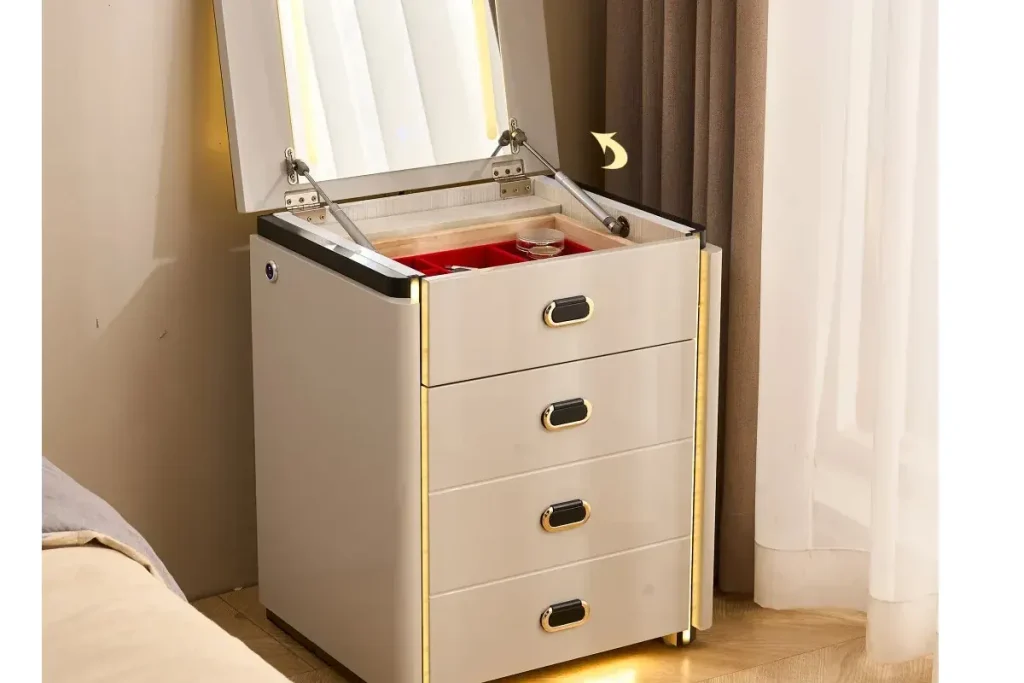
A flip-top lighted mirror is not the same as an ambient side light. The user may be closer to the light, and the function is more connected to grooming, small-item organization, jewelry storage, or compact bedroom routines. That means buyers need to check mirror angle, lid support, cable protection, switch position, light distribution, and heat around the mirror area.
A lighted mirror can be attractive for small bedrooms because it combines storage and a compact vanity function. It may also help dealers position the nightstand beyond a basic bedside cabinet. But it adds mechanical and electrical risks at the same time: the hinge, mirror panel, light strip, cable path, and storage tray all need to survive normal opening and closing.
This is where the broader article on the demand shift from nightstands to smart nightstands connects well. The market opportunity is not only adding electronics. It is adding functions that fit real bedroom behavior.
Buyer Checks for Supplier and Production Readiness
Before approving a lighted smart nightstand, procurement teams should confirm whether the supplier can repeat the lighting package across orders. The cabinet may be simple, but the lighting system includes strip quality, controller, adapter, sensor or switch, cable routing, fixing method, and after-sales parts. If any of these change without notice, the next batch may behave differently from the approved sample.
Buyers should request a clear bill of materials for the lighting components and keep photos or drawings of the approved installation. They should check whether wires are protected from drawer movement, whether connectors can loosen during transport, whether the adapter matches the target market, and whether the supplier can provide replacement parts.
The sourcing framework in smart nightstands and connected bedroom furniture applies directly. A smart function should be evaluated as a furniture feature, an electrical feature, and an after-sales feature at the same time.
Packaging and Shipping Risks
LED strips, controllers, sensors, mirror panels, adapters, and cables can be damaged by pressure, vibration, or careless assembly. A product may look fine when packed but fail after the customer moves a drawer, opens a mirror top, or plugs in the adapter. Packaging should protect visible light channels and prevent cables from being pulled during shipping or unpacking.
Instructions matter as well. If a customer does not understand the switch, dimmer, sensor, or adapter, the feature may be reported as defective. For dealer channels, a simple troubleshooting sheet can reduce unnecessary returns. For project furniture or serviced units, reset and replacement steps should be clear enough for a maintenance team.
For export orders, the points in bedroom furniture packaging and loading checks become more important when the furniture includes lighting and electrical components.
Dealer Opportunity: Make the Feature Easy to Understand
LED lighting can support better product storytelling, but the dealer should avoid vague claims. Instead of saying the nightstand is simply smart or modern, the product page can show the exact lighting use: warm side light for bedside atmosphere, floor light for night movement, drawer light for small-item storage, or mirror light for a compact vanity routine.
Short videos can work well because lighting is visual. A dealer can show the light turning on, the dimming range, the sensor response, and the nightstand beside a real bed. The goal is to make the feature understandable before the customer asks whether it is only decoration.
This also helps procurement. When the sales story is specific, the buyer can specify the feature more clearly. A supplier then knows whether the target is a soft night light, a display effect, a drawer convenience feature, or a lighted-mirror function.
Practical Checklist
- Define the lighting purpose: side ambient light, under-cabinet night light, drawer light, mirror light, or decorative accent.
- Check color temperature, brightness, dimming range, diffuser quality, and glare in a dark-room test.
- Confirm switch or sensor logic, trigger distance, delay time, memory behavior, and manual override.
- Inspect cable routing, connector protection, adapter requirements, and service access.
- Test the lighting with the final cabinet finish, mirror, glass, metal trim, and top surface.
- Protect LED strips, controls, sensors, mirror parts, cables, adapters, and instructions in packaging.
- Prepare after-sales answers for failed lights, sensor complaints, missing adapters, and replacement modules.
- Use clear photos and videos so dealers can explain the feature without overpromising.
Final Note
LED lighting can make a smart nightstand easier to understand than many hidden electronic features. Customers see it immediately, dealers can demonstrate it quickly, and buyers can use it to build clearer product tiers. But the feature only creates value when it is comfortable, controllable, repeatable, and serviceable.
A useful lighted nightstand is not the one with the brightest strip. It is the one where the light has a reason: helping the user at night, supporting a bedside routine, improving the display, or adding a compact mirror function without making the bedroom feel harsh or complicated.