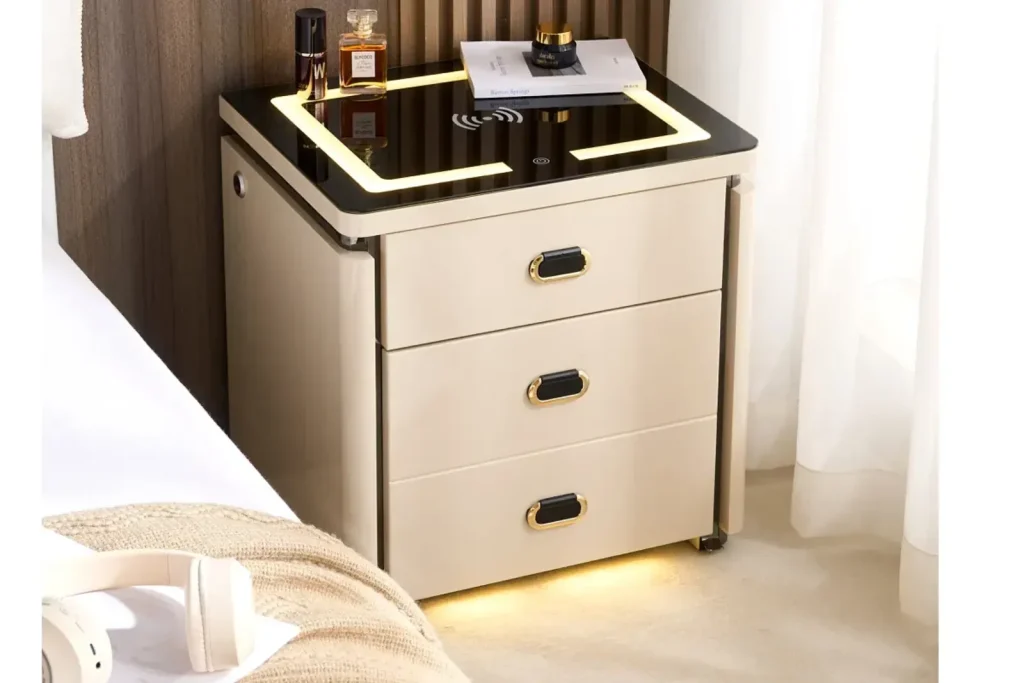
A Bluetooth speaker is a different smart nightstand feature from wireless charging or a lockable drawer. Charging solves a power routine. Private storage solves an organization problem. A speaker changes the bedside atmosphere: music, podcasts, white noise, audio books, short calls, or quiet background sound can become part of the nightstand’s daily use.
That makes the feature attractive, but also more sensitive. Audio is personal. Some customers will like the convenience, while others will worry about noise, pairing, privacy, volume control, and whether the product still feels like furniture rather than a gadget.
Kuan Zhang’s view is that a Bluetooth speaker should be treated as a user-experience feature, not only a module installed into a cabinet. If the audio is hard to pair, too loud at startup, weak in sound quality, or difficult to service, the feature can create more complaints than value.
How the Audio Feature Changes Bedside Use
The bedroom is not a showroom. People use a nightstand when they are waking up, preparing for sleep, reading, relaxing, or reaching for something in the dark. A built-in speaker can make the bedside area cleaner because the user does not need a separate portable speaker on the top surface.
It can also create a more complete product story. A smart nightstand with lighting, charging, storage, and audio feels like a small bedside station. For apartments, compact bedrooms, guest rooms, and serviced apartments, reducing separate devices can be a real advantage.
But the feature must stay quiet and controllable. A bedroom speaker should not surprise the user with a loud pairing sound at night. It should not reconnect unexpectedly at a high volume. The controls should be understandable without a long manual.
What Dealers Can Do With This Feature
For dealers, Bluetooth audio gives a simple demonstration angle. A salesperson can show lighting, place a phone on the charging area, and then play a short audio sample. That creates a stronger showroom moment than a standard bedside cabinet.
The feature also helps build a product ladder. An entry nightstand can focus on drawers and finish. A middle model can add lighting and charging. A higher model can add Bluetooth speaker audio, better surface materials, or a lockable compartment. This gives customers a clearer reason to compare models beyond color and price.
Online dealers can use the same logic in product pages. A short feature video, a close-up of the control area, and a clear list of what the speaker does and does not do can reduce confusion. The product should not be described as a full home audio system unless the hardware supports that claim.
What Buyers Should Specify Before Quotation
For buyers and importers, the speaker module should be specified as carefully as a runner, hinge, lock, or charging module. Basic questions include module type, power source, speaker position, control method, pairing behavior, startup sound, volume memory, Bluetooth version, cable routing, adapter requirements, and replacement method.
Buyers should also define the expected user scenario. Is the speaker mainly for soft bedtime music, podcasts, alarm audio, short calls, or general room sound? A product designed for quiet bedside use does not need to promise loud audio. It needs stable pairing, acceptable sound quality at low volume, and controls that do not disturb sleep.
The product specification guide for furniture buyers preparing quotation details is relevant here. A smart feature should be written into the specification before price comparison, otherwise suppliers may quote different modules under the same product photo.
Pairing and Controls Are Part of Product Quality
Customers judge Bluetooth audio quickly. If pairing takes too long, if the device name is unclear, if the connection drops, or if the speaker reconnects to the wrong phone, the user may blame the nightstand rather than the phone. That is why pairing tests should be part of sample approval.
Controls also need attention. Some products use touch buttons, some use physical buttons, and some depend on the phone. Buyers should test volume adjustment, power on and off, pairing reset, indicator lights, and how the speaker behaves after power loss. The control area should be visible enough for use but not so bright that it disturbs the bedroom.
This is similar to the sourcing logic in smart nightstands and connected bedroom furniture: the module is only one part of the product. Cable management, user instructions, spare parts, and service access decide whether the feature is manageable after delivery.
Sound Quality Should Match the Bedroom Use Case
A bedside speaker does not need to compete with a dedicated audio system. It needs to sound clean enough at low and medium volume, avoid harsh noise, and stay stable during normal use. Buyers should test voice content as well as music because many users listen to podcasts, audio books, or spoken content at night.
Speaker position affects the result. A speaker facing the wrong direction may sound muffled. A speaker placed inside a closed drawer area may vibrate the cabinet. A glossy top, hollow panel, or loose trim can create unwanted resonance. These problems may not appear in a product photo, but customers will notice them in a bedroom.
Privacy and Noise Need Careful Positioning
Audio functions make privacy and household comfort more important. A product page should not imply that louder is always better. In many homes, the best bedroom audio feature is controlled, quiet, and easy to stop.
Dealers should explain the feature as personal bedside audio, not a replacement for a living-room speaker. Buyers should check whether startup tones, pairing sounds or messages, and indicator lights are suitable for bedroom use. If the product will be sold to hotels, serviced apartments, or rental units, the reset process and device-name management become even more important.
Opportunity for Dealers and Procurement Teams
The dealer opportunity is differentiation. Many nightstands look similar in photos. A Bluetooth speaker feature gives a clearer upgrade story, especially when combined with lighting and charging. It can help a retailer build bundles around bedrooms, apartments, student housing, or compact living.
The procurement opportunity is repeatability. Once a buyer has tested a stable audio module, control layout, instruction format, and packing method, the same feature package can be adapted to different finishes, sizes, and bedroom collections. That is more useful than sourcing one eye-catching sample with no repeatable component plan.
The article on wireless charging in smart nightstands follows the same single-feature logic. Each smart feature should have its own buyer checks, dealer story, and after-sales plan.
Packaging and After-Sales Risks
Audio modules add parts that can fail or be misunderstood: speaker unit, control board, cable, power input, adapter, indicator light, and instruction sheet. If the module is damaged in shipping or the customer cannot pair a phone, the whole nightstand may be considered defective.
Packaging should protect the control area and prevent internal cables from being pulled during transport. The manual should include pairing steps, reset instructions, troubleshooting, power requirements, and basic safety notes. Spare modules, control boards, or speaker covers should be planned before mass shipment.
For export shipments, the packaging points in bedroom furniture packaging and loading matter even more when the cabinet includes electronic functions.
Buyer Checklist
- Test pairing with several common phones and check how quickly the speaker connects.
- Confirm device name, reset steps, startup tone, indicator light, and volume behavior.
- Test music, podcasts, and spoken audio at low and medium volume.
- Check whether the speaker position creates muffled sound, vibration, or cabinet resonance.
- Confirm module specification, power input, cable routing, adapter requirements, and compliance needs.
- Review whether the control area is visible, usable, and suitable for bedroom lighting conditions.
- Protect speaker parts, controls, cables, adapters, and instructions in packaging.
- Prepare after-sales answers for pairing failure, reset, replacement modules, and missing accessories.
Final Note
A Bluetooth speaker can make a smart nightstand feel more useful because it adds a daily audio function to the bedside area. For users, it can reduce separate devices. For dealers, it creates a simple demonstration and a stronger upgrade story. For buyers, it creates a repeatable feature package if the module, controls, instructions, packaging, and service plan are handled properly.
The feature should stay practical. A good speaker nightstand is not the loudest product in the showroom. It is the one that works calmly beside the bed, pairs reliably, sounds acceptable at normal bedroom volume, and remains serviceable after the sale.